RESOURCES

Last Updated
If you are running an AI agency in 2026, your website is doing one of two things: it is closing deals before you ever get on a call, or it is quietly costing you clients who looked, felt unsure, and moved on. The difference is almost never the quality of your service. It is almost always the quality of how your website explains, positions, and builds trust around that service.
The fastest way to get a credible, conversion-focused AI agency website live is a premium Framer template built specifically for this space. Not a generic SaaS template with the word “AI” swapped in. A template designed around the actual content structure, visual language, and buyer psychology that converts AI agency prospects.
This guide breaks down the best options available in 2026 — what each one is built for, who it works best for, and how to choose the right one for your specific agency type.
What Makes a Framer Template Actually Work for an AI Agency
Before getting into specific picks, it is worth understanding what separates a template that converts from one that just looks good. Most template buyers focus entirely on aesthetics. The agencies landing high-ticket clients are thinking about structure.
Here is what the best AI agency templates have in common:
Technical credibility built into the layout. Your buyers are often non-technical but they are buying something technical. The template needs to translate complexity into clarity — dedicated sections for your process, capability lists, case studies, and integrations that signal “we know what we are doing” without requiring a 500-word explanation.
A hero section that states the outcome, not the technology. The worst AI agency websites lead with the tech. “We use GPT-4, LangChain, and custom agentic workflows.” Nobody outside your industry cares. The best templates have hero sections structured around the outcome: “We automate the workflows that are costing your team 20 hours a week.”
Multi-page architecture. A single-page site works at the zero-to-one stage. Once you have services to explain, case studies to show, and a team to introduce, you need pages. The best templates ship with six to twelve pre-built pages covering everything from Home to Case Studies to a dedicated pricing flow.
CMS-ready structure. Your template should let you add new case studies, blog posts, and team members without rebuilding pages. This matters more than any visual feature because it determines whether your site stays current or goes stale six months after launch.
Conversion architecture, not just design. Every section should have a job. Hero generates interest. Services build credibility. Case studies provide proof. Pricing removes friction. CTA closes. Templates that treat every section as decorative rather than functional will look great and convert poorly.
The Best Framer Templates for AI Agencies in 2026
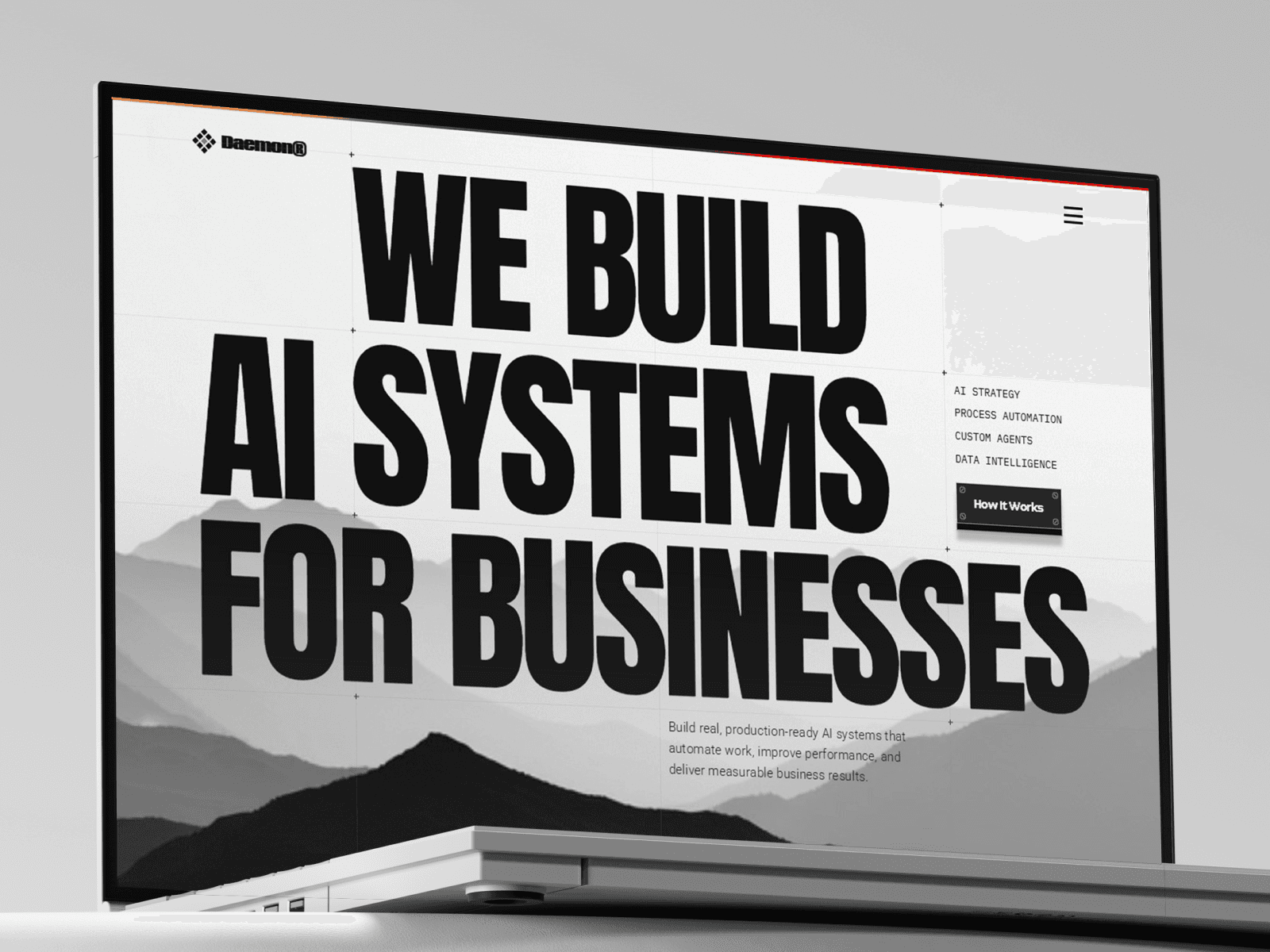
1. Daemon — Best for AI Automation and Workflow Agencies
Price: $129 | Pages: 8+ | CMS: Yes
Daemon is built specifically for AI agencies, automation studios, and workflow consultancies. If your agency helps businesses replace manual processes with intelligent automation — think AI agents, Make.com buildouts, Zapier replacements, or custom GPT integrations — Daemon’s layout maps directly onto how you would explain your services.
What stands out: The hero section is structured around outcomes, not technology. The services section uses a clear process-first layout that makes complex technical offerings readable to non-technical buyers. Case study sections are CMS-powered, meaning you add new projects directly in Framer without touching the design.
Best for: AI automation agencies, workflow consultancies, agentic AI studios, anyone whose primary offer involves replacing or augmenting human workflows with AI.
What you give up: Less product-page depth than Spartan. If you sell a standalone AI tool or model alongside your services, Daemon does not have a dedicated product showcase page.
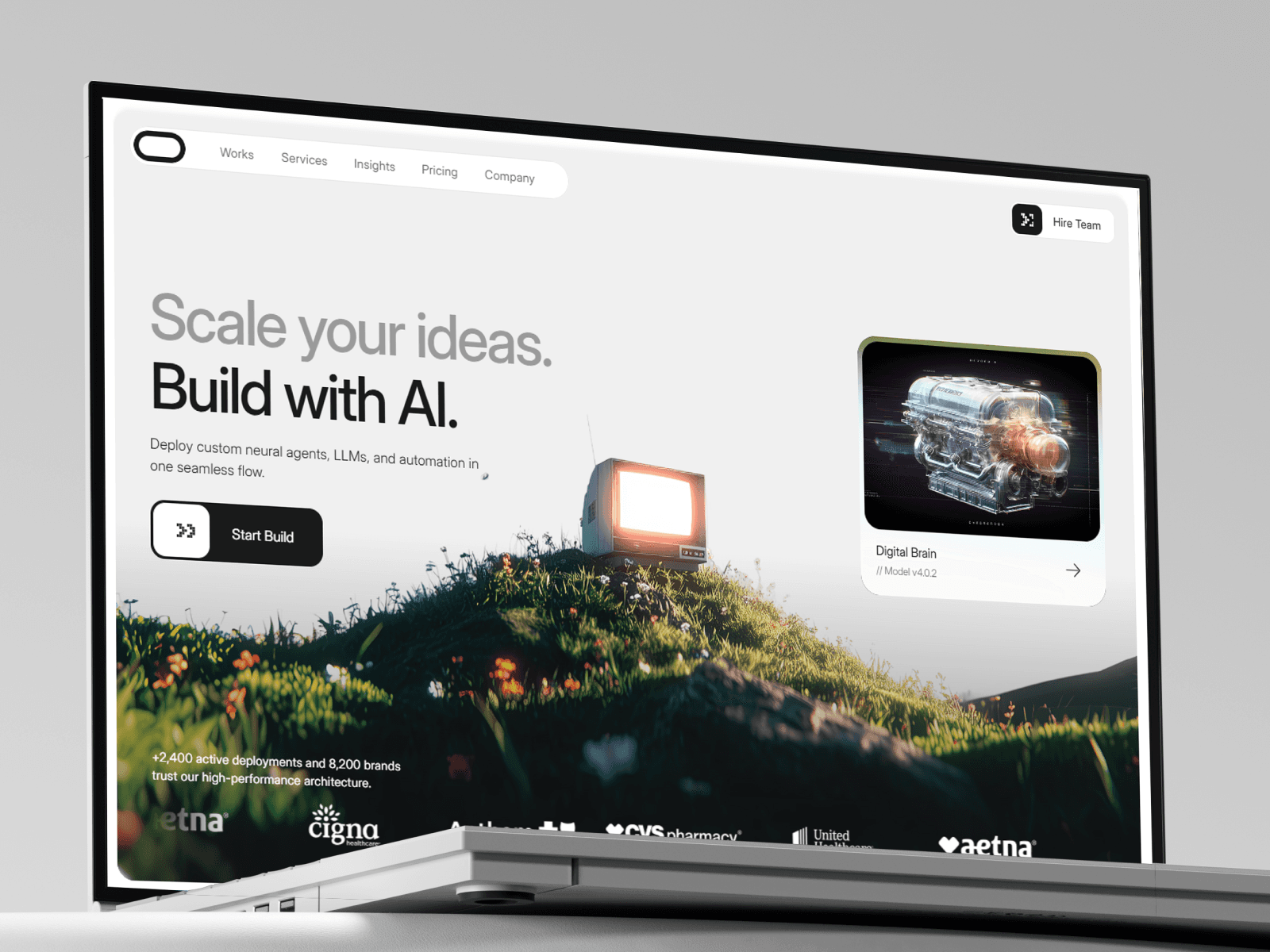
2. Spartan — Best for Technical and Research-Focused AI Agencies
Price: $129 | Pages: 10+ | CMS: Yes
Spartan is the most technically credible template on this list. It was built for AI research labs, LLM consultancies, neural engineering firms, and agencies working with enterprise clients on data sovereignty, on-premise AI deployment, or custom model fine-tuning.
The design language is deliberately different from every other template here. Where most AI agency templates lean into gradient aesthetics and animation-heavy layouts, Spartan uses a “black-box” visual approach — deep mesh gradients, frosted glass components, dense information grids — that reads as serious engineering rather than polished marketing.
What stands out: The Digital Brain product page is unique. It is a dedicated landing page for selling a standalone AI product or model alongside your agency services — complete with technical specification tables, inference speed benchmarks, and semantic search capability sections. No other template in this category ships with this.
Best for: AI research labs, LLM fine-tuning consultancies, neural engineering firms, technical AI agencies working with Fortune 500 clients, any agency whose positioning is “serious engineering partner” rather than “automation vendor.”
What you give up: The technical aesthetic that makes Spartan powerful for its target buyer can feel cold or inaccessible to clients in less technical industries. If your buyers are SMB founders rather than enterprise CTOs, Armory is a better fit.
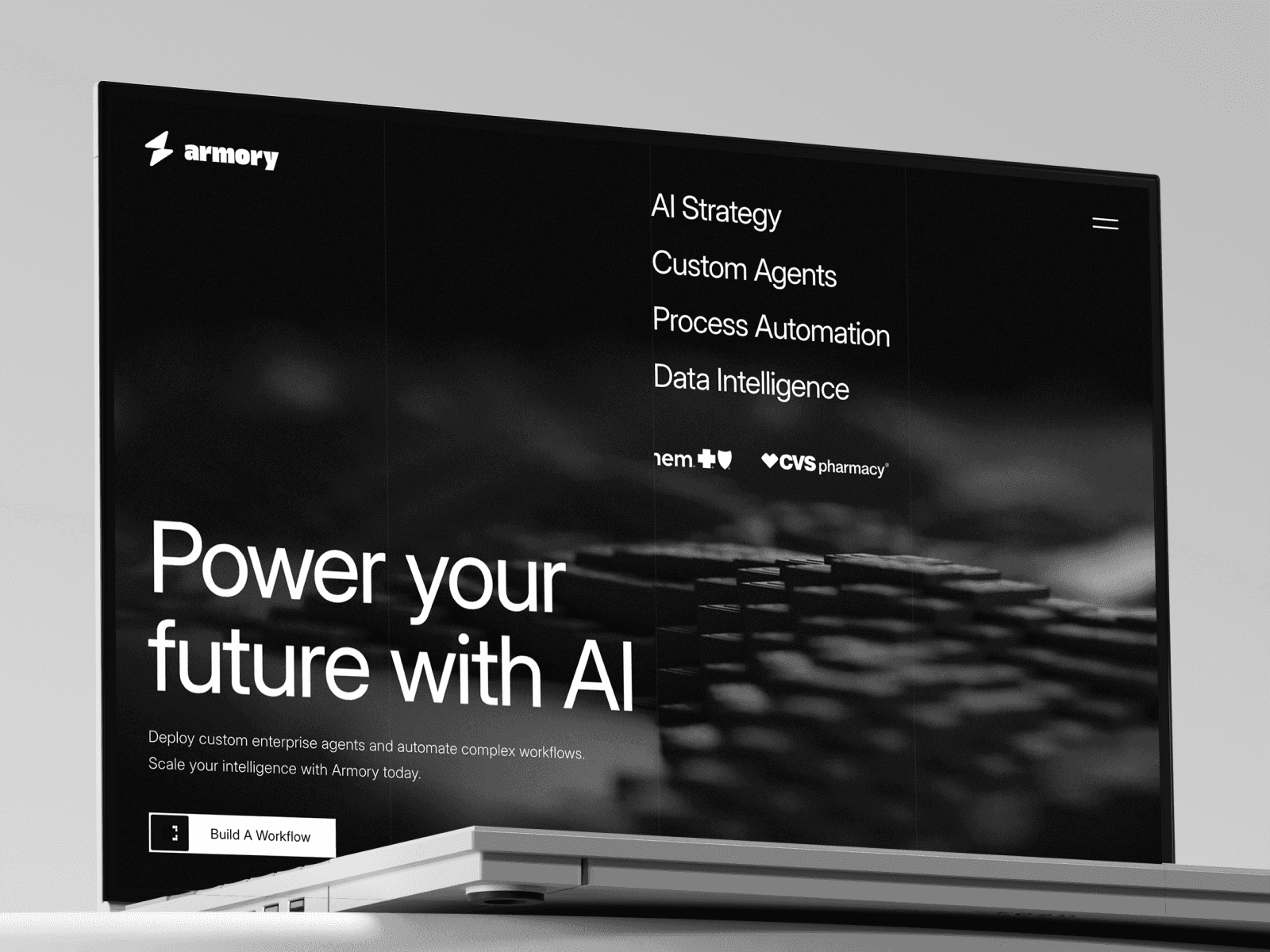
3. Armory — Best for Broad AI Consultancies and SaaS-Adjacent Teams
Price: $129 | Pages: 9+ | CMS: Yes
Armory sits between Daemon and Spartan in terms of positioning. It is clean and enterprise-ready without the intensity of Spartan, and more structured and credibility-focused than a typical SaaS template.
The layout is designed around presenting AI services clearly to clients who may not fully understand what they are buying. Strong visual hierarchy, clear capability sections, and a logical progression from “what we do” to “how we do it” to “what it costs” make Armory the most broadly applicable template on this list.
What stands out: Armory ships with pre-built pages for Home, About, Services, Case Studies, Pricing, Contact, Articles, and Projects — the most complete multi-page structure of any template here. The case study CMS is particularly strong, supporting rich text, project images, client names, outcomes, and categorisation.
Best for: AI consultancies with multiple service lines, automation agencies targeting mid-market clients, SaaS teams with an agency component, any AI business that wants a premium finish without committing to a hyper-specific technical aesthetic.
What you give up: Less differentiation from other “premium agency” templates than Daemon or Spartan. Armory looks exceptional, but it does not have a single design signature that makes it immediately recognisable as an AI-specific template.
Comparison Table: Daemon vs Spartan vs Armory
Feature | Daemon | Spartan | Armory |
|---|---|---|---|
Price | $129 | $129 | $129 |
Pages included | 8+ | 10+ | 9+ |
CMS collections | Yes | Yes | Yes |
Blog/Articles | Yes | Yes | Yes |
Product page | No | Yes | No |
Case studies | Yes | Yes | Yes |
Best buyer type | SMB/Mid-market | Enterprise/Technical | Mid-market/Broad |
Design aesthetic | Dark, premium | Industrial, data-heavy | Clean, structured |
Coding required | No | No | No |
Who Should Use Which Template
Choose Daemon if: Your agency builds AI automations, custom agents, or workflow integrations. Your buyers are business owners, operations leads, or founders — not CTOs. Your typical project involves replacing manual processes rather than engineering novel AI systems.
Choose Spartan if: Your agency works with enterprise clients on LLM infrastructure, model fine-tuning, data sovereignty, or on-premise AI systems. Your buyers are technical. You want your website to project serious engineering authority rather than accessible agency polish.
Choose Armory if: Your offer spans multiple service types — consulting, automation, and possibly a productised service. You want the most complete template out of the box. You are not sure yet which specific niche your agency will settle into and you want something that works across all of them.
How to Evaluate Any Framer Template Before Buying
Before purchasing any template, run it through these five checks:
1. Check the demo on mobile. Over 60% of first visits happen on a phone. If the demo looks broken or compromised on mobile, skip it regardless of how good the desktop version looks.
2. Count the actual pages. Template listings often say “multi-page” and deliver three pages. Count them in the demo and confirm each page you need exists.
3. Look for CMS usage. Click into case studies, blog posts, or team members in the demo. If they exist as static hardcoded sections rather than CMS items, adding your own content will require rebuilding those sections.
4. Test the actual animations. Some templates use heavy animation that looks impressive in screenshots but slows the page significantly or feels overwhelming during real browsing. Scroll through the demo at normal speed and see if the animations add to or distract from the experience.
5. Check the creator’s update history. Framer templates require occasional updates as Framer’s platform evolves. A template with no updates in over a year may have broken components or outdated interactions.
The Cost of Getting This Wrong
A generic template communicates that you did not care enough to find something built for your specific audience. For a high-ticket AI agency selling $5,000 to $50,000 engagements, that perception has a direct cost.
A template purchased for $129 and customised in a day will outperform a generic free template every time — not because it looks better, but because the structure has been designed around the specific trust signals, content hierarchy, and conversion flow that AI agency buyers respond to.
Once you have picked a template, the next question is how to arrange its sections for maximum conversion — see How to Structure an AI Agency Website That Converts in 2026 for the full page architecture.
Related Reading
FAQ
What is the best Framer template for an AI agency? Daemon, Spartan, and Armory are the three templates built specifically for AI agencies, each designed for a different type of agency and buyer. Daemon suits automation-focused agencies, Spartan suits technical and enterprise-focused agencies, and Armory suits broad consultancies and mid-market agencies.
Do I need to know how to code to use these templates? No. All three templates are fully no-code. You replace text, images, case studies, and pricing content directly in Framer’s visual editor and publish without writing any code.
How long does it take to customise a Framer template for an AI agency? Most agencies can go from purchase to published in one to two days. The core sections — hero, services, and contact — take a few hours. Adding case studies and refining copy typically takes another few hours.
Can I customise the design of a Framer template? Yes. Framer gives you full control over colours, typography, layout, and components. The template is a starting point, not a constraint.
What is the difference between a Framer template and a custom website? A custom website is designed from scratch around your specific brand and offer. A template gives you a pre-built structure that you customise with your content. Templates are significantly faster and cheaper; custom builds offer more differentiation. See the full comparison in Framer Template vs. Custom Build.
Are Framer templates good for SEO? Yes. Framer generates clean, fast HTML with proper heading structures and supports custom meta titles, descriptions, and Open Graph data per page. Combined with good on-page content, Framer sites rank well. See our full breakdown of how to launch an AI agency website that ranks.



Resources