RESOURCES
Last Updated
The five sections every strong AI agency website gets right are not the ones most agencies focus on. Most agencies spend their energy on visual design, colour palettes, and which animation library to use. The sites that actually convert spend their energy on structure, messaging hierarchy, and trust architecture.
This guide breaks down what the best AI agency websites have in common — not in terms of aesthetics, but in terms of the decisions that turn visitors into booked calls and paying clients.
Why Most AI Agency Websites Fail to Convert
Before looking at what works, it is worth being direct about what does not.
The technology trap. The most common mistake AI agency websites make is leading with technology rather than outcomes. “We use GPT-4, LangChain, vector databases, and custom agentic pipelines” communicates almost nothing to a business owner who needs their support tickets resolved faster. The technology is the how. The outcome is the why. Lead with the why.
The credential vacuum. AI is a trust-intensive service. Clients are handing over proprietary data, workflows, and sometimes core business processes. A site with no proof — no case studies, no testimonials, no named clients, no visible track record — asks for enormous trust while providing zero evidence it is warranted.
The vague positioning problem. “We help businesses leverage AI to drive growth” describes every AI agency on the internet. Vague positioning means you compete on price rather than fit. The strongest AI agency sites have a clear, specific positioning statement that either names the industry they serve, the problem they solve, or the outcome they deliver.
The wall of jargon. AI agencies often write for their peers rather than their clients. LLM, RAG, embeddings, agentic workflows, multi-modal systems — these terms mean nothing to most buyers. The sites that convert translate technical capability into business language.
Section 1: The Hero — Where Every Visitor Decides Whether to Keep Reading
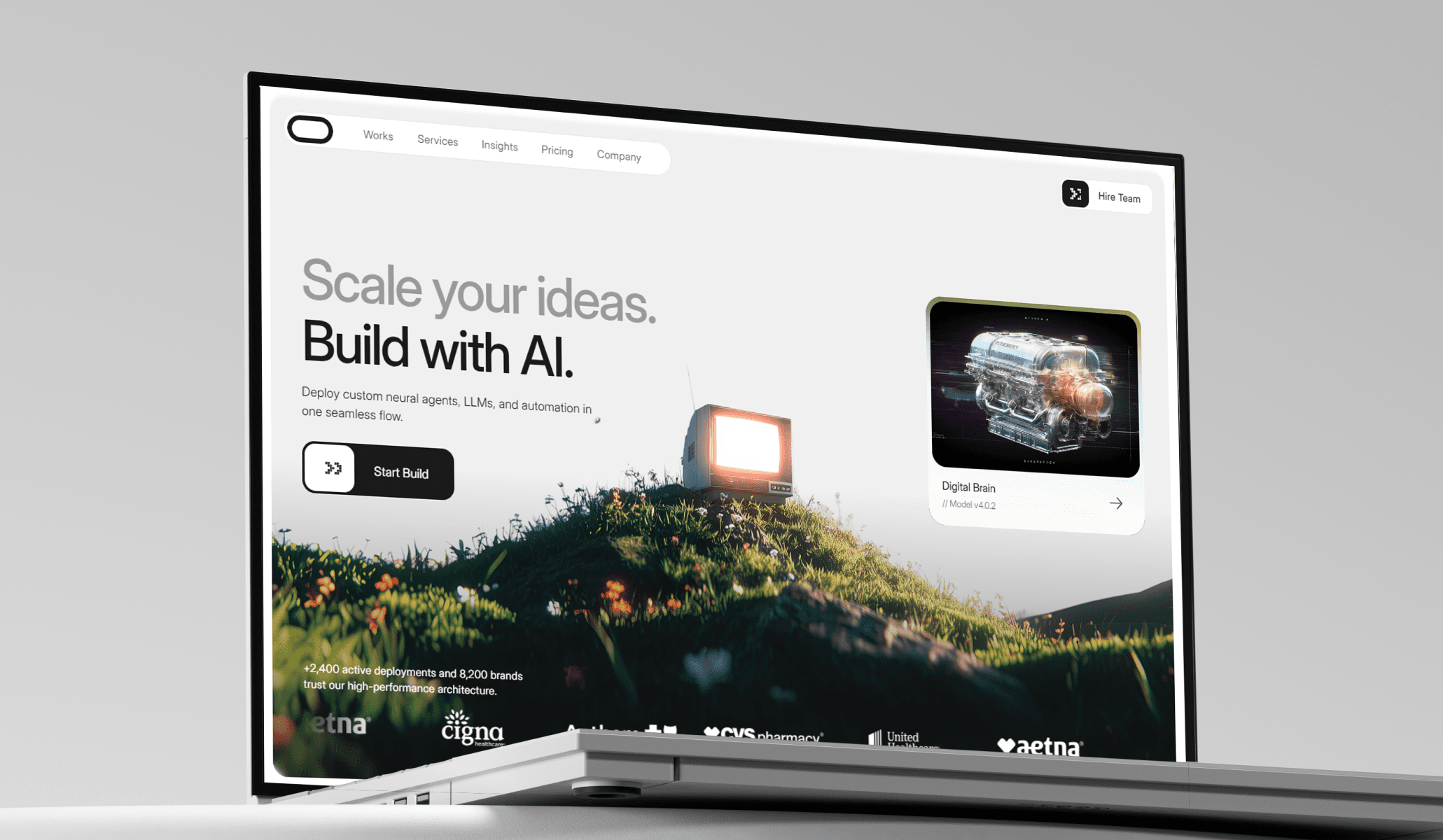
The hero section has approximately four seconds to communicate three things: what you do, who you do it for, and why someone should care. Everything else on the page gets read only if the hero earns it.
What High-Converting AI Agency Heroes Get Right
Outcome over technology. The headline leads with what the client gets, not what tool you use to deliver it.
Weak: “AI-Powered Workflow Automation for Modern Businesses” Strong: “We cut your support ticket resolution time by 70% — using AI agents your team can actually manage.”
A specific, credible subheadline. One sentence that adds context to the headline. Who you serve, how you deliver, or what makes you different.
Example: “We build custom AI integrations for e-commerce operations teams. Average deployment: three weeks. Average time saved: 22 hours per week per team.”
A single, clear CTA. Not two buttons. Not “Learn More” paired with “Get Started.” One primary action that moves the visitor forward: “Book a Discovery Call,” “See How It Works,” or “View Our Work.”
Social proof above the fold. A client logo strip, a review count, or a single strong testimonial. This does not need to be elaborate — even “Trusted by 40+ teams across 12 countries” works if it is true.

Section 2: Services — Making Technical Offers Readable
The services section is where most AI agencies either build credibility or lose it. Done right, it makes complex technical offerings immediately understandable to non-technical buyers. Done wrong, it reads like a capabilities deck that nobody asked for.
What High-Converting Service Sections Do Differently
They name outputs, not activities. “Custom LLM Development” is an activity. “A trained AI model that answers customer questions with 90% accuracy without a human in the loop” is an output. Buyers buy outputs.
They speak to the buyer’s pain, not the agency’s capability. Before stating what you build, acknowledge what problem it solves. “Most customer support teams spend 40% of their time on repetitive questions. We fix that.” Then describe how.
They use three to five services maximum. Longer service lists signal either lack of focus or lack of confidence. The agencies with the most differentiated positioning typically offer two to four services and go deep on each.
They group related services under a clear theme. Rather than listing eight standalone services, strong sites group them: Build (we deploy your AI infrastructure), Integrate (we connect AI to your existing tools), and Scale (we maintain and improve over time).
Service Description Template
Use this structure for each service:
Name the service in plain language
State the problem it solves in one sentence
Describe how you deliver it in one to two sentences
Quantify the outcome where possible
Optional: name the types of clients it works for
Section 3: Case Studies — The Most Underused Trust-Building Tool
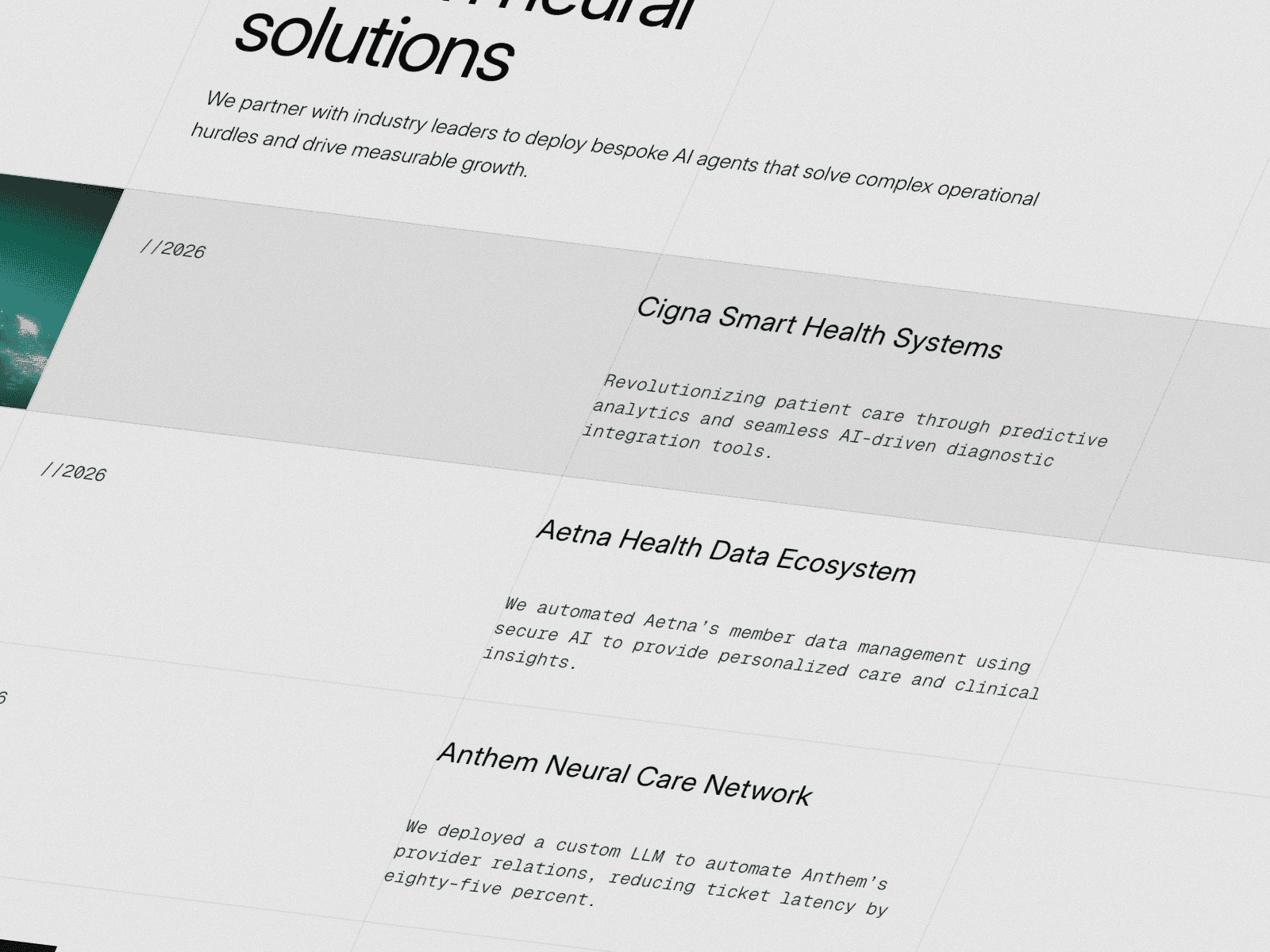
Case studies are the single highest-converting content type on an AI agency site, and they are consistently the most neglected. Most agencies either have no case studies at all, or they have vague summaries that communicate nothing of substance.
What Makes a Case Study Convert
Specificity. “We helped a client improve their operations” converts nobody. “We helped a 40-person logistics company reduce manual data entry by 85% by building a custom AI agent that processes supplier invoices automatically” is specific enough to make a prospect think “we have that exact problem.”
The before/after structure. Every strong case study has an explicit before: what the client was doing before your engagement, what pain that caused, what it was costing them. And an explicit after: what you built, how long it took, and what measurably changed.
Honest timelines. Clients want to know how long this will take. A case study that says “deployed in three weeks” is more compelling than one that is silent on timeline.
At least one number. Time saved, error rate reduced, revenue attributed, cost cut, response time improved. One concrete number makes the entire case study credible.
Minimum Viable Case Study Format
If you do not have polished case studies yet, this structure works:
Client: E-commerce operations team (30 people)
Problem: Processing 200+ supplier invoices manually, taking 3 hours daily
Solution: Custom AI agent built on GPT-4, integrated with their ERP via API
Result: Invoice processing time cut from 3 hours to 12 minutes daily. 94% accuracy rate. Team redeployed to higher-value work.
Timeline: 4 weeks from brief to deployment
Section 4: Pricing — Why Transparency Converts Better Than Gatekeeping
The instinct for most AI agencies is to hide pricing and “get them on a call.” The reasoning: every project is custom, so stating prices upfront seems misleading, and prospects who know the price before getting on a call might not book one.
This logic has a significant flaw. Prospects who do not know what something costs before they book a call will ask on the call. If the number is higher than they expected, you have wasted both your time and theirs. The prospects who book a call knowing your approximate price range are better qualified before they even open the Zoom link.
What High-Converting Pricing Sections Include
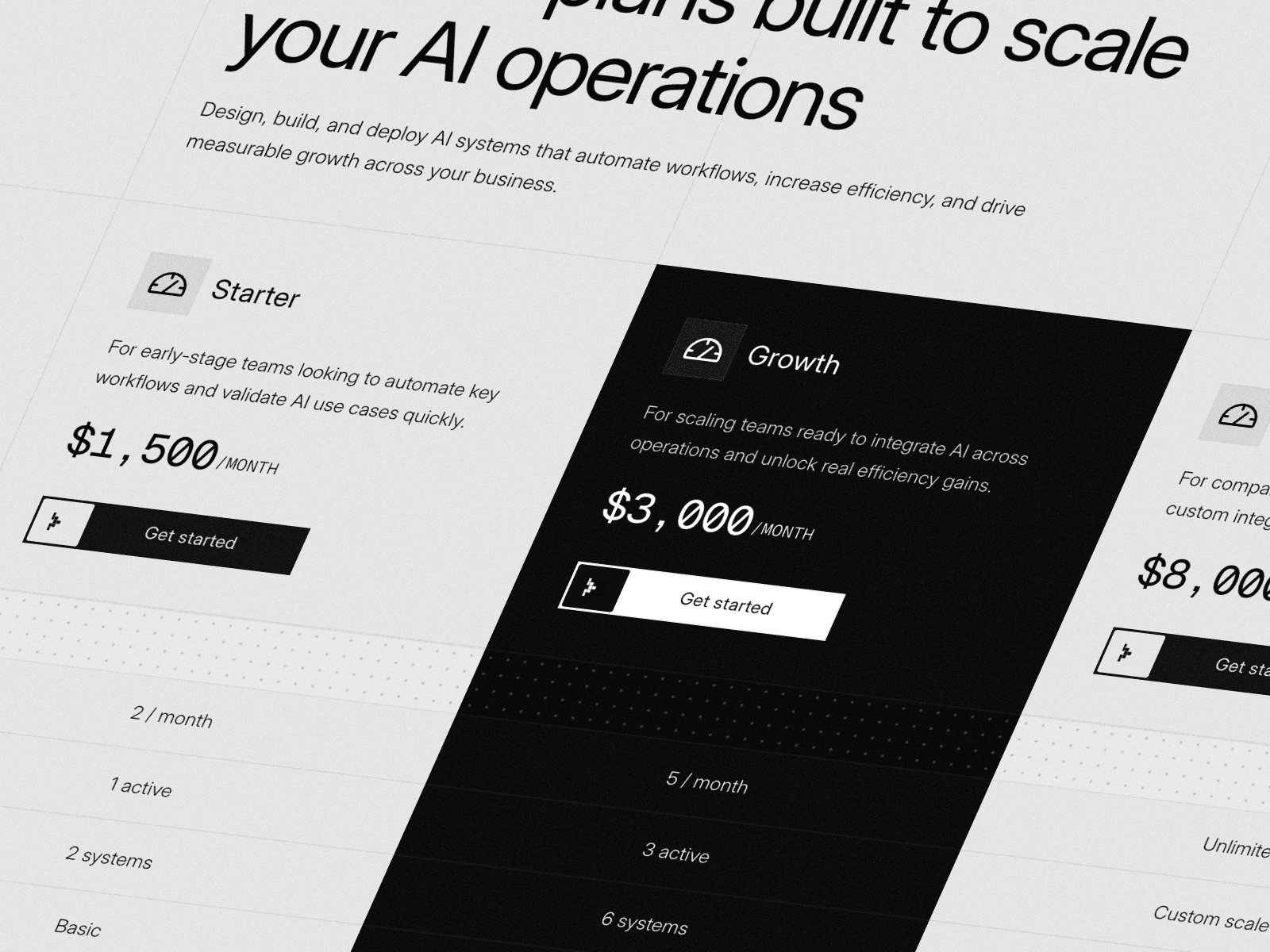
Starting-from pricing. Even “Starting from $3,500” tells prospects whether they are in the right ballpark. It filters out tire-kickers before they reach your calendar.
Three tiers or packages. A structure like Audit, Build, and Scale — or Starter, Growth, and Enterprise — lets prospects self-select. The middle tier typically converts best.
Outcomes per tier. Not features. Outcomes. “This package gives you a deployed AI agent in 3 weeks” not “This package includes discovery, architecture planning, development, and QA.”
A clear next step. Every pricing section should end with one action: book a call, send a message, or request a proposal.
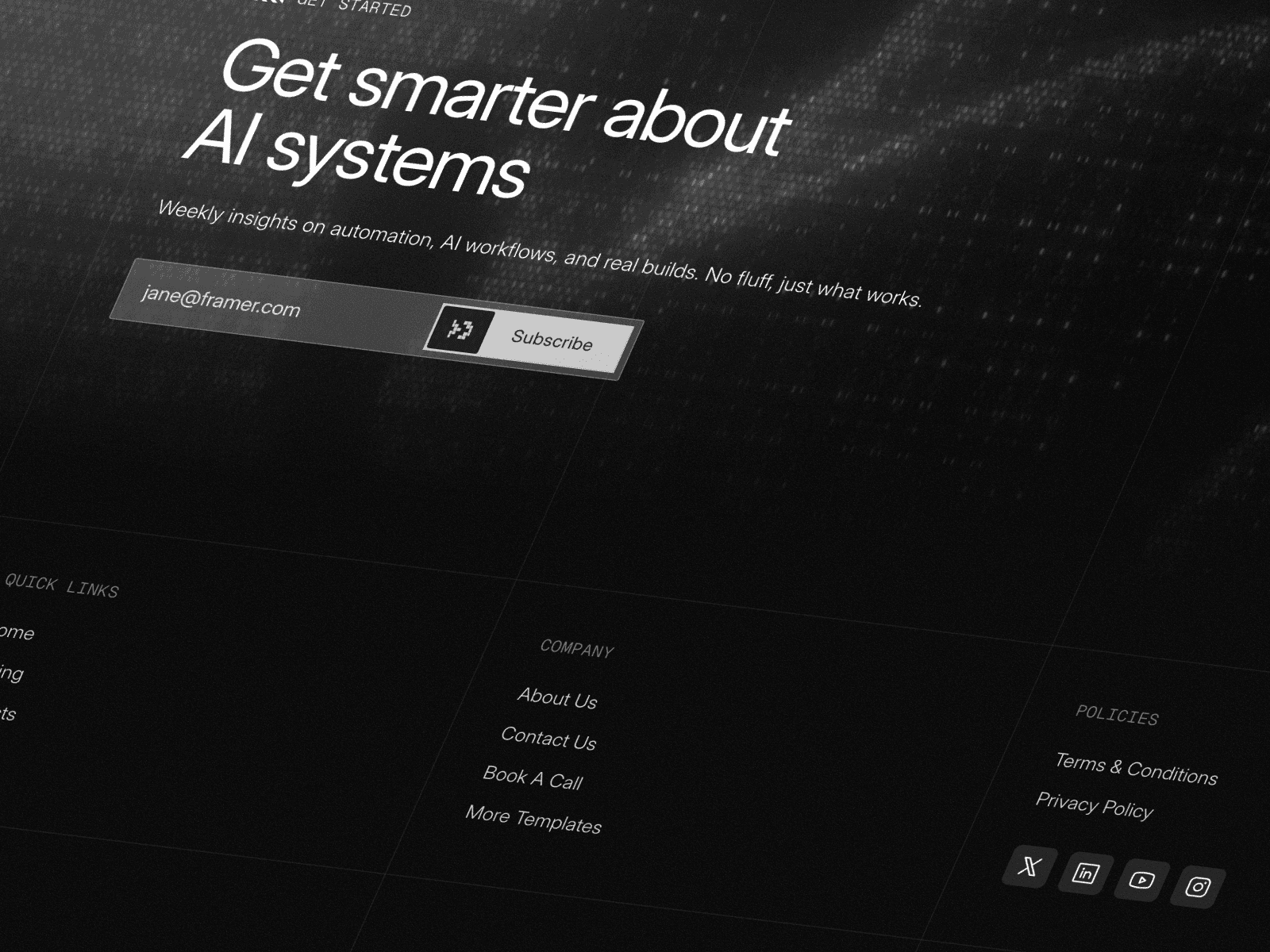
Section 5: The Contact Flow — Where Interested Visitors Become Leads
Most AI agency sites treat the contact section as an afterthought. A form, an email address, maybe a phone number. The strongest sites treat it as the final act of the conversion sequence — one last moment to reassure the visitor they are making the right decision.
What High-Converting Contact Sections Include
A reassurance statement above the form. “Most projects launch within four weeks of our first call. We respond to every enquiry within 24 hours.” This removes friction at the point of conversion.
A short, focused form. Name, email, message. Not a twelve-field form asking for company size, annual revenue, tech stack, and project start date. Every additional field reduces form completion rate.
A direct calendar link. Alongside the form, offer a direct booking link (Cal.com, Calendly, or similar). Some prospects prefer to book immediately rather than wait for a response.
Social proof nearby. A testimonial immediately above or below the form. “Working with them was the fastest we have ever moved on a project — Natia K, Viral Marketing Lab” removes doubt at the moment of commitment.
The Conversion Checklist: Review Your Site Against This
Use this checklist to identify gaps in your current site:
Hero
Headline leads with client outcome, not technology
Subheadline specifies who you serve and how
Single primary CTA with clear action language
Social proof element above the fold
Services
Three to five services maximum
Each service leads with the problem it solves
Outcomes quantified where possible
Plain language, minimal jargon
Case Studies
At least two case studies with specific before/after
At least one number in each case study
Timeline mentioned
Industry of client specified (even if anonymised)
Pricing
Pricing section exists (even if “starting from”)
Three tiers or packages visible
Outcomes per tier, not features
Clear CTA on pricing section
Contact
Reassurance statement above form
Short form (name, email, message maximum)
Direct calendar link available
Testimonial nearby
How to Get There Fast
The fastest way to implement all of the above is to start with a template that already has the right structural architecture and replace the content with yours.
The three Framer templates designed specifically around AI agency conversion architecture:
Armory — Best for broad consultancies. Most complete page set available.
Daemon — Best for automation agencies. Strong process and case study sections.
Spartan — Best for technical agencies. Credibility-first layout for enterprise buyers.
Full comparison and template details: Best Framer Templates for AI Agencies in 2026.
For step-by-step launch guidance: How to Launch an AI Agency Website in a Day Using Framer.
For the section-by-section logic behind the examples above, see The AI Agency Website Homepage: Every Section Explained for what to put in each part of the page.
Related Reading
FAQ
What should an AI agency website include? At minimum: a clear outcome-focused hero, a services section in plain language, two to three case studies with specific results, a pricing section or starting-from price, and a contact form with a direct booking link.
How many case studies do I need on my site? Two strong, specific case studies outperform six vague ones. Quality and specificity matter more than volume. Start with two and add more as you complete projects.
Should I show pricing on my AI agency website? Yes, or at minimum show a “starting from” price. Hiding pricing entirely causes better-qualified prospects to self-select out before booking a call, and worse-qualified prospects to book calls that end when they hear the price.
How long should the homepage copy be? Long enough to answer the four questions every prospect has: what do you do, who is it for, does it work (proof), and what does it cost. Most effective AI agency homepages are between 600 and 1,200 words of visible copy.
What is the most important section on an AI agency website? The hero section. It is seen by 100% of visitors. Every other section is seen only by the fraction of visitors who were convinced by the hero to keep reading.



Resources